


You can select each level of the captured screen element’s hierarchy in the Screen Elements tree to display the details automatically detected by Real-Time Designer in the Identification tab.
The Terminal Emulation connector supports the following HLLAPI screen element types:
HLLAPI Edit
HLLAPI Screen
HLLAPI Session
Terminal Process
To view HLLAPI Edit screen element details:
| 1. | Select the captured screen element in the Screen Elements tree and click the Identification tab: |
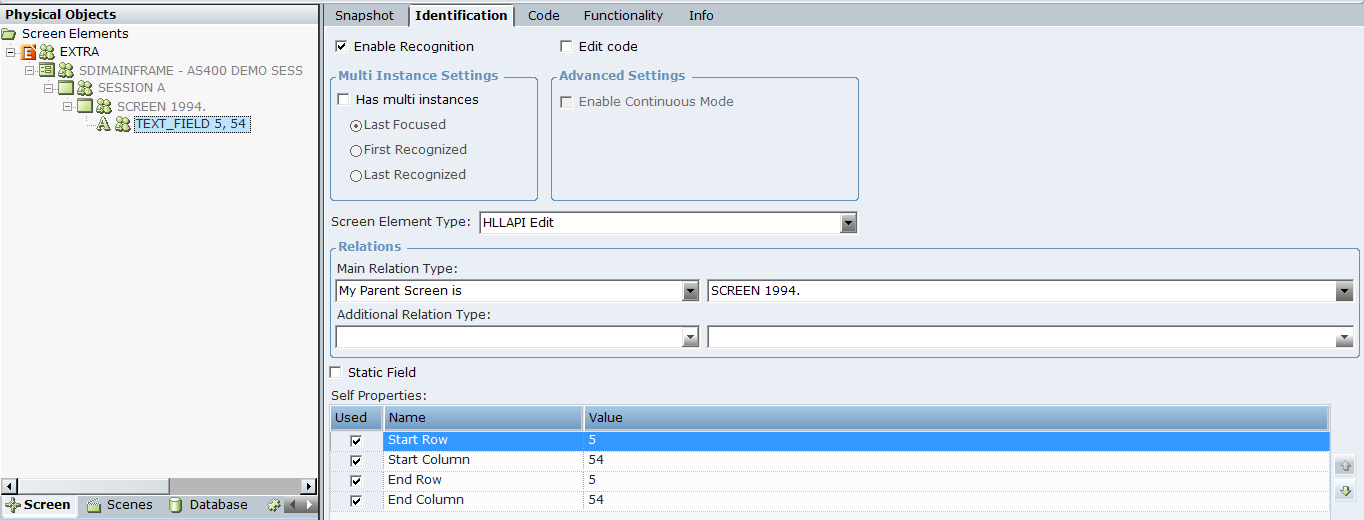
| 2. | In the Screen Element Type, select HLLAPI Edit from the drop-down list. |
For Terminal connector, only one item appears in the Screen Element Type drop-down list that corresponds to a type of screen element that has been captured:

| 3. | Click the Main Relation Type drop-down list to show the available relations types for the screen element. |

My Parent Screen is: Shows the parent object of the captured HLLAPI Edit control. For this control type, the parent is the HLLAPI screen element that is specified in the drop-down list next to the Main Relation Type drop-down list.
Additional Relationship Type drop-down list is disabled for HLLAPI Edit screen element in the Identification tab.
| 4. | The Self Properties section lists the properties that can be used to uniquely identify the HLLAPI Edit screen element type. Real-Time Designer automatically selects the best properties to identify screen elements, and selects them in the Used column. For more information, see Self Properties of a Screen Element: |

Start Row: The number of the row where the HLLAPI cell starts.
Start Column: The number of the column where the HLLAPI cell starts.
End Row: The number of the row where the HLLAPI cell ends.
End Column: The number of the column where the HLLAPI cell ends.
The default order of the Self properties for these screen elements cannot be changed in the System Settings window.
For HLLAPI Edit screen elements, all four self properties are automatically selected for identification.
| 5. | To specify that the captured HLLAPI Edit object is a static cell in the Terminal application and cannot receive the value, go to the Identification tab and select Static Field . |
| 6. | To determine if the HLLAPI Edit object might have multi instance objects, click the Has multi instances checkbox . |
Has multi instances checkbox is clear by default if you captured a HLLAPI Edit screen element.
For more details how to activate the multi instance feature, see Multiple Instances
To view details of HLLAPI Screen screen element:
| 1. | In the Screen Elements tree, select the HLLAPI Screen screen element, and click the Identification tab. |
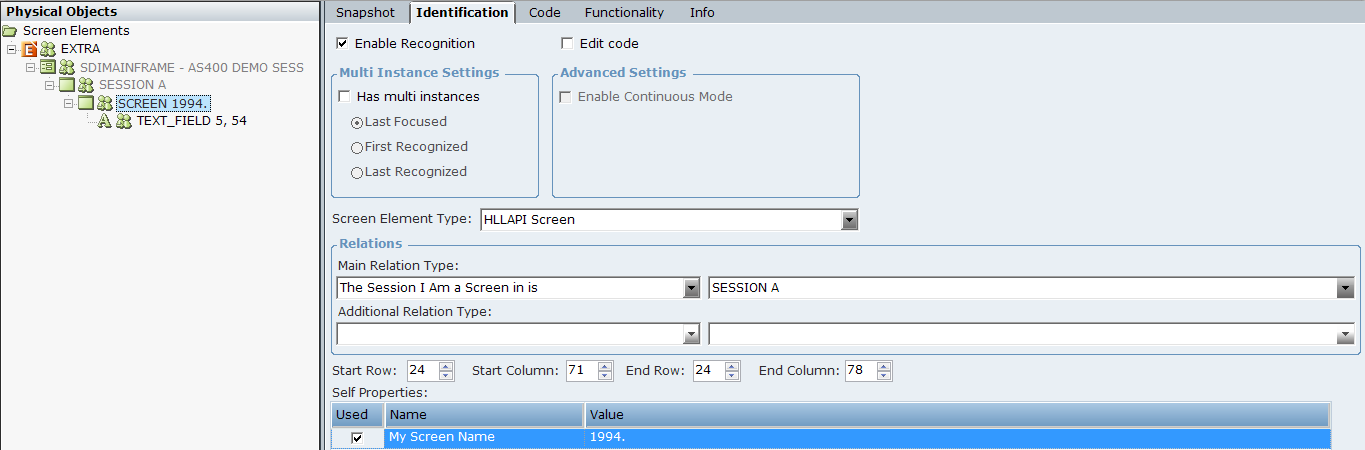
To select a HLLAPI Screen screen element you need to display hidden captures. See Capturing a HLLAPI Screen Element
| 2. | From the Screen Element Type drop-down list, select HLLAPI Screen. |

| 3. | Click the Main Relation Type drop-down list to show the available relations types for the HLLAPI Screen screen element. |
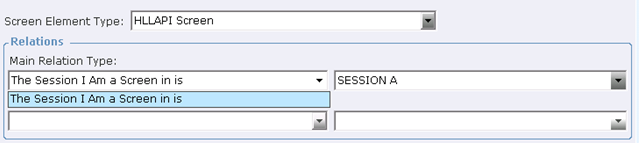
The Session I Am a Screen in is: Shows the parent object of the captured HLLAPI Screen control. For this control type, the parent is the HLLAPI Session element that you specified in the drop-down list next to the Main Relation Type drop-down list.
Additional Relationship Type drop-down list is disabled for HLLAPI Screen screen element in the Identification tab.
| 4. | The Self properties section provides only one self property that is used to uniquely identify a HLLAPI Screen screen element. Real-Time Designer automatically selects this property by selecting it in the Used column. For more details, see Self Properties . |

My Screen Name: The name of the HLLAPI Screen object.
| 5. | If you need to customize the size of the HLLAPI Session screen element, change the values in the Identification tab that defines the area of the session itself. |

Real-Time Designer handles the area of the Terminal’s session automatically when capturing a HLLAPI object.
| 6. | Select the Has multi instances checkbox to determine if the HLLAPI Screen object has multi instance objects. |
Has multi instances checkbox is clear by default if you captured a HLLAPI Edit screen element.
For more details how to activate the multi instance feature, see
To view HLLAPI Session screen element details:
| 1. | In the Screen Elements tree, select the HLLAPI Session screen element, and select the Identification tab. |
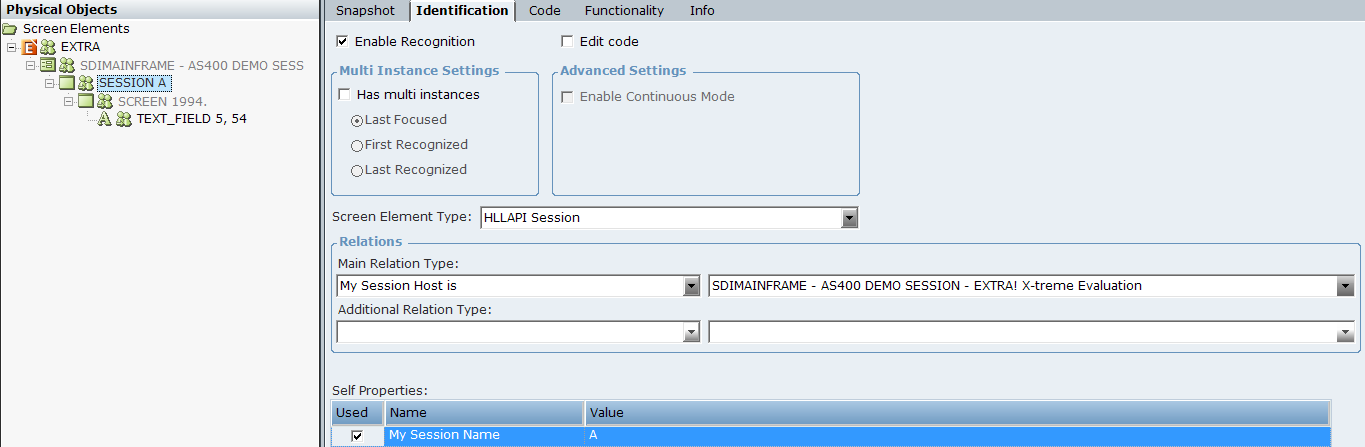
To select a HLLAPI Screen screen element, you need to display hidden captures. See Capturing a HLLAPI Screen Element.
| 2. | The type of the screen element is HLLAPI Sessionn in the Screen Element Type drop-down list. |

| 3. | Click the Main Relation Type drop-down list to show the available relations types for HLLAPI Session screen element. |
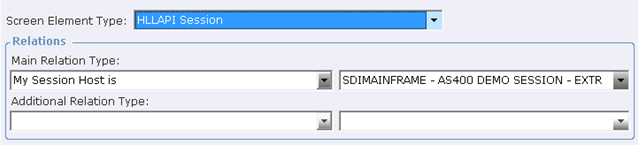
The Session Host is: Shows the parent object of the HLLAPI Session control. For this control type the parent usually is Win32 form that specified in the drop-down list next to the Main Relation Type drop-down list.
Additional Relationship Type drop-down list is disabled for HLLAPI Screen screen element in the Identification tab.
| 4. | The Self properties section provides only a one self property that used to uniquely identify a HLLAPI Session screen element. Real-Time Designer automatically selects this property by checking it in the Used column. For more details, see Self Properties . |

My Session Name: The name of the HLLAPI Session object.
| 5. | Select Has multi instances to specify that a HLLAPI Screen object has multi instance objects. |
Has multi instances is not selected by default if you captured a HLLAPI Edit screen element.
For more information about using multi-instances functionality, see Multiple Instances.
To view Terminal Process screen element details:
| 1. | In the Screen Elements tree, select the Process Screen element, and click the Identification tab. |
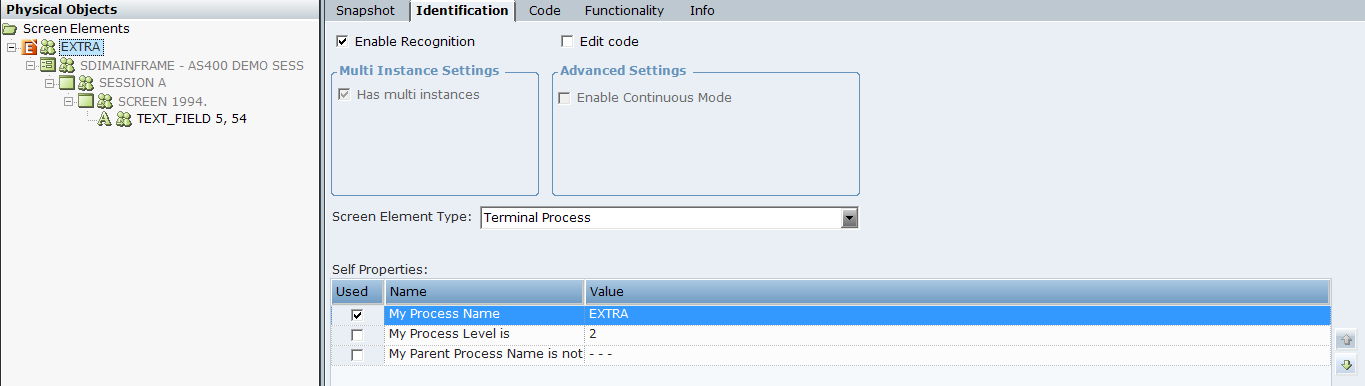
The Relations section does not appear for a Process screen element type.
The type of the screen element is Terminal Process in the Screen Element Type drop-down list.

| 2. | The Self Properties section provides only one self property that is used to uniquely identify the process. Real-Time Designer automatically selects this property by selecting it in the Used column. For more details, see Self Properties . |

My Process Name is: Provides the name of the process of Terminal application in the process tree.
You can use the Process Explorer utility (or standard Windows Task Manager) to verify the name of the process.
My Process Level is: Specifies the level of the process in the process tree, thereby enabling you to handle scenarios where applications have more than one process on different levels.
You can use the Process Explorer utility to verify the process level.
My Parent Process Name is not: Provides the name of the process, which cannot be a parent process (the process one level higher).